California's Legal Market Is Shrinking. Here's How Brands Are Adapting.
CRC Manufacturing · August 20, 2026 · 3 min read
California's licensed market has contracted every year since its roughly $5.8 billion peak in 2021. The operators still expanding through that contraction largely share one structural decision: they stopped owning production.
The pressure list
The illicit market is estimated at around 60% of consumption, against 40% for the legal channel — a ratio that puts a hard ceiling on legal pricing regardless of quality. On top of that, licensed operators are absorbing rising electricity costs, higher minimum wages (Santa Rosa's sits at $18.21), category saturation, and limited banking access.
The consequences are visible in employment. In August 2026, Santa Rosa's CannaCraft announced roughly 60 layoffs across production and trimming. Local governments have started responding on the tax side too: San Luis Obispo County cut its cannabis business tax from 8% to 6% effective October 1, 2026.
Why owned production fails first
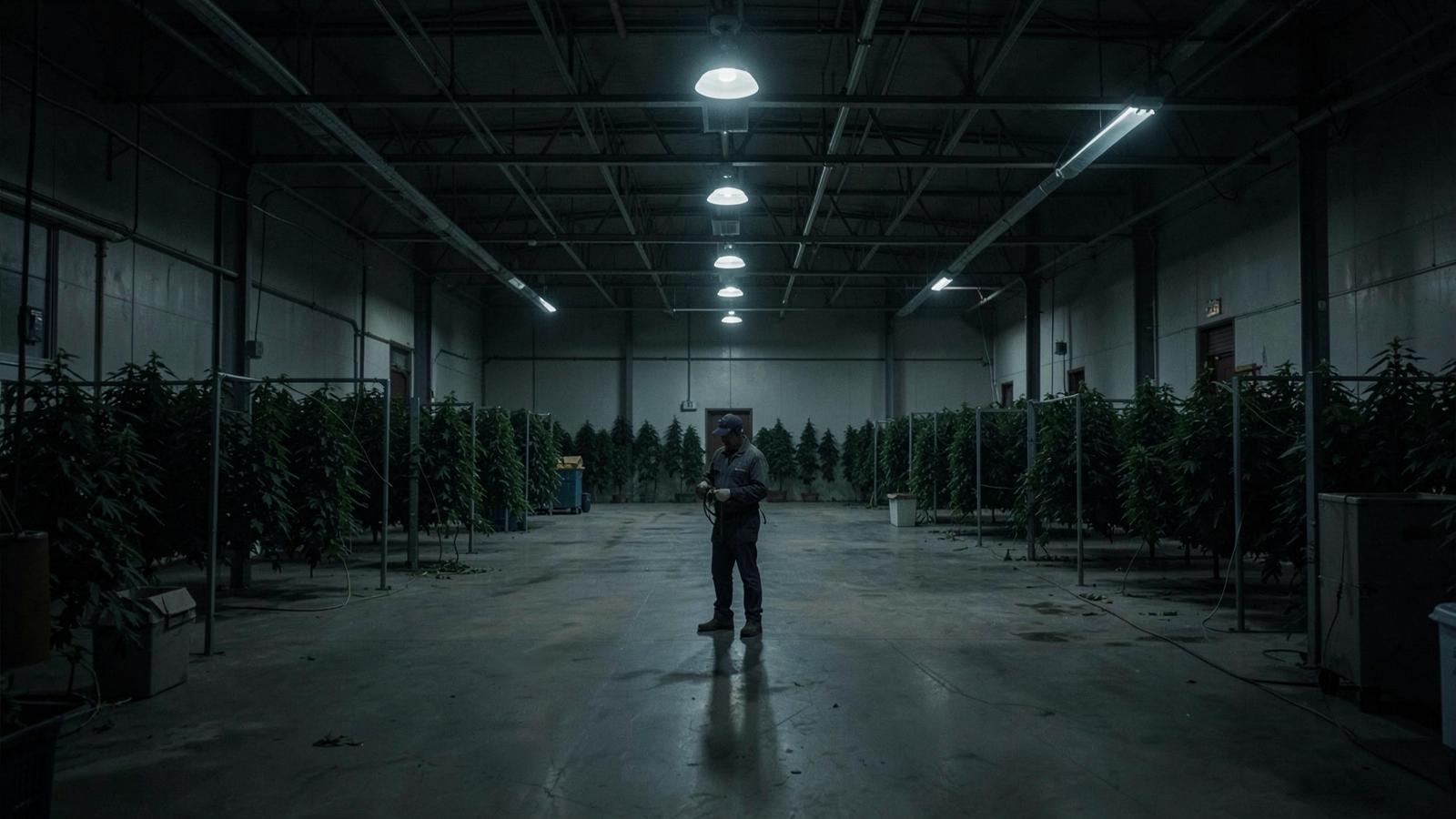
A facility is a fixed-cost machine. Rent, licensing, insurance, equipment leases, and a core payroll are due whether the line runs one shift or none. When demand is growing, that fixed base is leverage — every additional unit gets cheaper. When demand contracts, it inverts, and the same base makes every unit more expensive precisely when you have fewer of them to spread it across.
That is the mechanism behind most of the shutdowns of the last three years. It is rarely a bad product. It is a cost structure that assumed volume would keep climbing.
The per-unit alternative, with numbers
Consider a brand producing 20,000 pre-rolls a month. Running its own line, assume a conservative $25,000 per month of fixed overhead — space, licensing, equipment, core labor — before materials. That is $1.25 per unit of overhead at full volume. Cut volume to 8,000 units in a slow quarter and the same overhead becomes $3.13 per unit, with no change in what the customer receives.
Co-packed, the same brand pays a published per-unit rate — for a 0.5g in a tube, rolling at $0.30 plus packaging at $0.20 — and pays it only on units actually produced. Eight thousand units costs 40% of what twenty thousand costs. The cost curve follows demand instead of fighting it.
What the adaptation looks like in practice
The brands handling the contraction well tend to run a narrower SKU set, hold less finished inventory, and treat production as a variable line item they can resize quarterly. They spend on the things that are actually scarce — shelf placement, brand, buyer relationships — rather than on square footage.
None of that requires giving up control of the product. Specs, materials, and formulation stay with the brand. What changes is who carries the fixed cost of the equipment when the market has a bad quarter.